.

.
Showing posts with label Wellington Trip. Show all posts

Wednesday, March 9, 2016

Long drive home

We covered LOTS of territory on our drive back from Wellington to Auckland. Not all of New Zealand is the lush green tropical bush that we have become so familiar with.


We were on the road for about 11 hours.   It was a LONG day.   We did stop at one familiar place along the way to get out and stretch our legs - the Tongariro National Trout Center.   We had been there last March when we went down to Tauranga with Sister Winters and her family that time Elder Winters had to go to Vanuatu at the last minute.  Larry was driver for the group and got to take Gary's spot on the long planned fishing trip.

However, that time when we stopped at the trout center even though we very much enjoyed the walking trails (and found a couple geocache there), the museum and aquarium had been closed.  This time everything was open for business so it was fun to walk around and see the displays.


Soon enough, however, it was time to get back on the road!


We caught glimpses of Lake Taupo through the windshield, but there was no more stopping for us.   We were ready to get home.


 There were LONG, LONG, LONG stretches between towns where we saw a lot of open country...mile after mile (or kilometers as they would say here) of windy road with pastures or bush on either side.   I know I've mentioned this before, but there are a WHOLE lot of sheep in this country!  (More sheep than people, they say.)   New Zealand does not do rest stops so we have learned to carry plenty of water, fruit and crackers with us where ever we go, and fortunately were able to make it  between pit stops for our other needs.  (Whew!).   We were road weary indeed by the time we reached our apartment in Takapuna.  Still, we were glad we got a chance to see more of the country and gain an even better appreciation for this remarkable Land of the Great White Cloud.  

Tuesday, March 8, 2016

Family History with Papakowhai Ward

We had a great night working with members in the Papakowhai Ward, Porirua Stake on Tuesday night.  The energy in the room was electric as people searched for info about the ancestors.  Sometimes the veil between this world and the next feels very thin indeed and we are certain that the spirits of the generations that went before are among us, guiding us in where to look.


Monday, March 7, 2016

Te Papa Museum

One of our favorite things in Wellington was visiting the Te Papa Museum.  It was a remarkable experience!


We enjoyed the displays throughout the museum - the giant squid, the Maori history, and so much more.   But one of the most powerful exhibits was the Gallipoli Scale of War exhibit. that has been created by Sir Peter Jackson and his team.


"This ground-breaking exhibition tells the story of the Gallipoli campaign in World War I through the eyes and words of eight ordinary New Zealanders who found themselves in extraordinary circumstances.   Each is captured frozen in a moment of time on a monumental scale – 2.4 times human size. The large-scale sculptures took a staggering 24,000 hours to create, and countless hours were spent researching their rich histories.  Cutting-edge technology was used to create 3-D maps, projections, miniatures, models, dioramas, and interactive experiences to bring this story to life.  In total, 2,779 Kiwis lost their lives on Gallipoli, and many others were scarred for ever.
 Gallipoli: The scale of our war takes you to the core of this defining event."


The larger-than-life statues of the eight different people were remarkable in detail.  But it was the other parts of the exhibit - the letters, quotes, and every-day artifacts such as dental tools that were used to treat soldiers who had teeth break off when biting into the hard tack crackers they were given to eat....all the minutia that was a part of the lives of the people involved in that war that really touched my heart.


I am so grateful that neither my husband nor my sons ever had to be in a combat situation.   Larry was born in 1945 so he was in the prime age group to go to Viet Nam.  However, since he was married and had a family and also a college student, he was never drafted.    Both of my sons served in the Marine Corps, one in active duty for 9 years and the other as a reservist.  For them, Desert Storm could have taken them into some very ugly situations.  There were two or three times that  our younger son had orders to go, but each time something was changed at the last minute to keep him stateside.  I am convinced it was influenced at least in part by the fasting and prayers in his behalf to keep him safe.

We live in troubled times when indeed there are "wars and rumours of war" in many places throughout the world.   We know from prophecies in both the Bible and Book of Mormon that the last days will be filled with much conflict and strife.   But war is nothing new.  As we read of all the battles between the Nephites and the Lamanites or the terrible destruction caused by the Gadianton Robbers from Book of Mormon days our hearts are grieved for what those people had to go through.
As we hear more and more about conflicts throughout the world it is easy to feel frightened or overwhelmed.  At those times I cling to scriptures such as “Fear not, little flock. … Look [to Christ] in every thought; doubt not, fear not” (D&C 6:34, 36).
In 2004, Elder Jeffrey R. Holland gave a wonderful talk for a church educational system fireside that was later printed in Ensign magazine titled "This, the Greatest of All Dispensations."  Having made these remarks not that long after the September 11, 2001 terror attacks on the USA, Elder Holland addressed the fear that many people experienced about living in troubled times..   He said:
"So, in a world of tribulation, let’s remember our faith. Let’s recall the other promises and prophecies that have been given, all the reassuring ones, and let’s live life more fully, with more boldness and courage than at any other time.
Christ has overcome the world and made a path for us. He has said to us in our day: “Gird up your loins and be prepared. Behold, the kingdom is yours, and the enemy shall not overcome” (D&C 38:9).

Seeing the museum exhibits about the Gallipoli battles was a grim reminder of the ugly reality of war that seems to spreading throughout the corners of our world today.   It was humbling to think of all the millions of men and women - both soldiers and civilians - who have either lost their lives or come home maimed in fights to maintain freedom.  However, through our testimonies in the Gospel of Christ, we really can hold on to hope and remain confident, even though we live in troubled times.  
This mission experience has taught me more than ever before that I truly can trust in a loving Heavenly Father to give us strength to face whatever adversity may come our way.  

P-Day in Wellington


Senior Missionaries work hard, but we also enjoy chances to relax and do a bit of sight seeing where ever our assignments may take us.   On Monday we had the day off, so we went into Wellington to explore.   Having being at the tippy top of our North Island when we visited Cape Reinga, it was fun to now be seeing the extreme bottom part of the island.

"Wellington, the capital of New Zealand, sits near the North Island’s southernmost point on the Cook Strait. A compact city, it encompasses a waterfront promenade, sandy beaches, a working harbour and colourful timber houses on surrounding hills. Though sunny and mild most of the year, strong winter winds through the Cook Strait give it the nickname "Windy Wellington." "  (Wikipedia)


We drove up to the top of Mt. Victoria to take in the panoramic views of the city (and also found a geocache there!). We walked around the city a bit and spent some time in the museum. I was grateful for my sweet husband's sense of direction because more than once I got turned around not knowing how to find our way from where we were back to our car, but he always manages to find our spot.

 In the afternoon I did a bit of hiking along a lovely forest trail while Larry laid back and took a snooze.  (Since January I have been working hard to get at least 10,000 steps in every day so every chance I get I go for a walk).

That evening we had a training meeting with FHC director Sister Mary Edwards in Wellington Stake.   Normally we don't do any meetings on Monday nights since that is reserved for Family Home Evening.  However that was the time that worked best for her, and as a single sister with no other family at home she was available then.


We were disappointed that we were not ever able to get an appointment with the Stake Presidency in Wellington but our time with Sister Edwards was very worthwhile.

All in all we felt our trip to region was being well spent.  We felt grateful for the experiences we were having.

Sunday, March 6, 2016

Porirua & Upper Hutt Stakes

We finally arrived in Plimmerton early Saturday evening.  We checked in to the HomeAway apartment where we would be staying and found it to be lovely, as we usually do.  We save a lot of money by staying in local rent-by-owner places rather than motels and they are usually way more charming.  We took a drive across the harbor bridge to find the Porirua Stake Center since we would have meetings there early the next day.  We wanted to be sure we knew where we would be going.


Photo from Porirua Salvation Army Webpage


Although there were definite signs of autumn turning, there were still lots of flowers blooming.
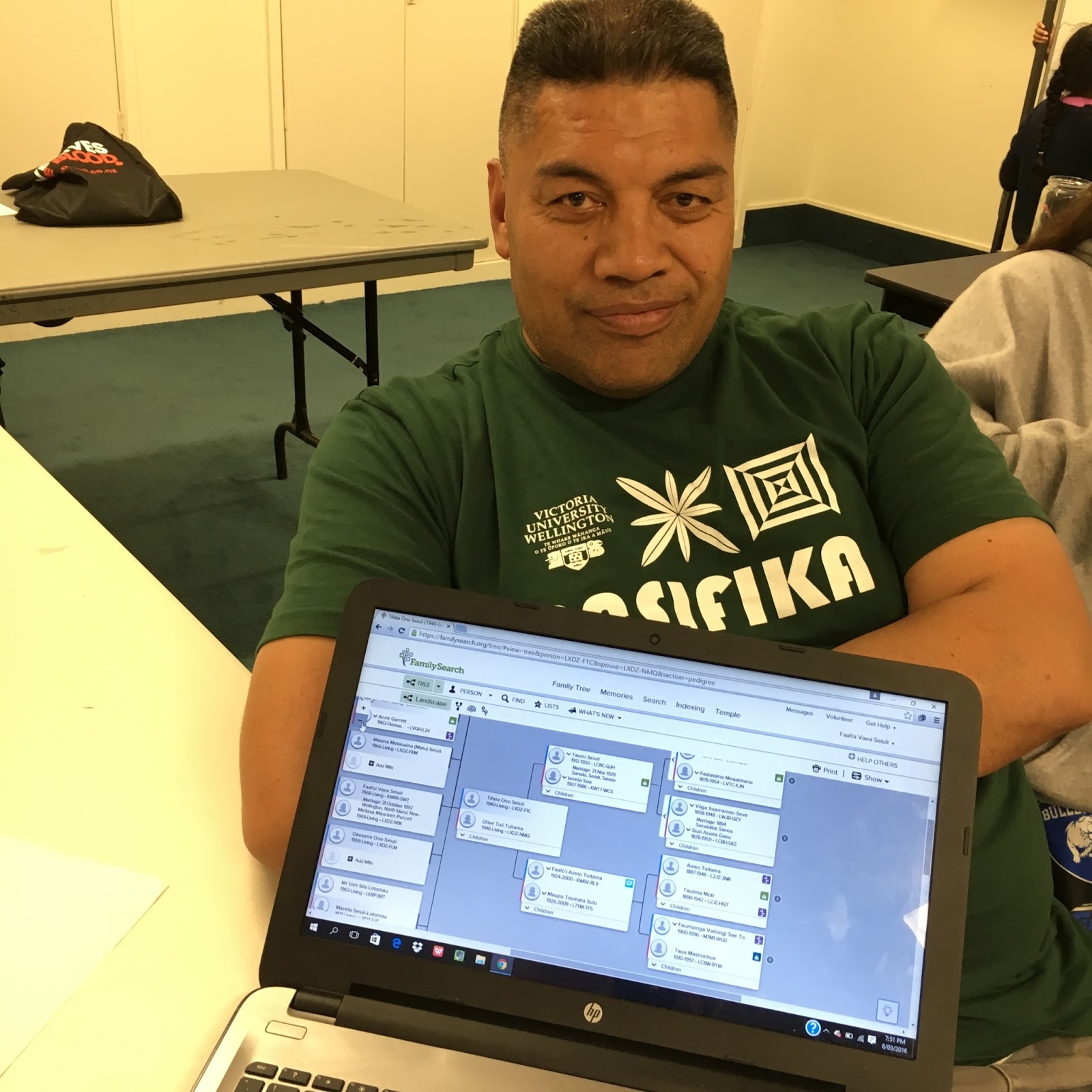
At 8:00 AM on Sunday morning we met with the full Stake Council from Porirua Stake.  They were very receptive to hearing about the Find / Take / Teach message we are sharing and about the Family History workshop we are suggesting be held on an ongoing basis.  Several of the leaders asked good questions.  It was great to have the auxiliary leaders there as well as the Priesthood so they all could get the information and discuss ideas for how this could impact the individuals they serve.  After the meeting Brother Saovao asked us if we could come to his ward's family history night on Tuesday to help train members in how to Find / Take / Teach.  We were happy to accept.

Stake President Roberts (left) and High Council Adviser over Family History - Bro Joseph Saovao


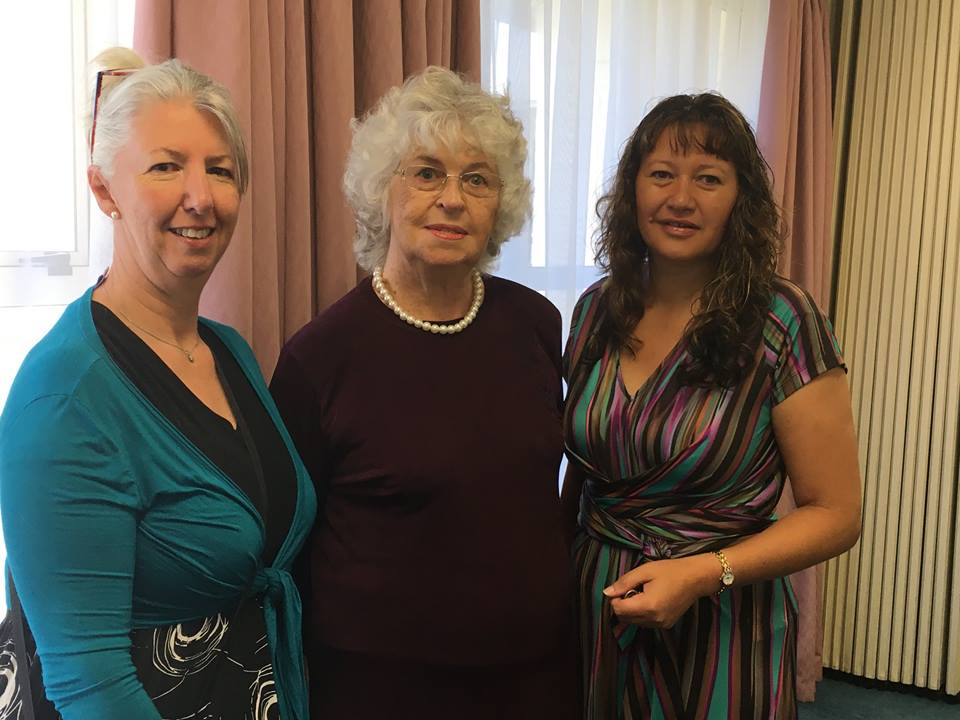
Our next meeting with with the Porirua Stake Family History Center director and two other women who help staff the center.  They were eager to learn all they could.

Adele Arthur, Lois Wineera and FHC Director Ranei Parai
We then attended Sacrament meeting in the Papakowhai Ward, which happened to be the ward where we would be coming back on Tuesday to help with the Family History Night.   It was fast and testimony meeting, so I got up and bore my testimony about the importance of family history work and let people know that we would be there to help them to find family names to take to the temple.  Afterward several other members spoke of experiences they had with family history.   The spirit of Elijah was so strong in that meeting!

After the meeting we got to visit briefly with the Document Capture missionaries serving in that area.  Elder and Sister France (on left in photo below) were preparing to leave and were being  replaced by Elder and Sister Tacher.  What a great group of missionaries!  We could tell the ward members had come to know and love Elder & Sister France in a very personal way.   Also from the enthusiasm of the Tachers we knew they would be every bit as committed to getting involved in the ward and making a difference.


After our meetings in Piorua we traveled over to Upper Hutt Stake.  There we met with FHC Director Iris Paha, 1st Counselor in Stake Presidency, Ricky Miller, and High Council Advisor over Family History Gary Pene


We were particularly impressed by Brother Pene.  He had previously been serving as the Stake Technology Specialist so he has an excellent understanding of the computer system and knows FamilySearch well.  More importantly, he has a personal testimony of  the importance of family history work and the positive impact it can have in the lives of members.

Over and over we see that even though FamilySearch is a computer based program, the most important thing we can bring in our trainings is opportunities for leaders and members to gain that personal witness about the work - far more than any tech instruction.


Finally, with all our meetings done for the day, we returned to our sweet little spot in Plimmerton for some much needed rest.   The weather was turning cold and rainy so it felt good to be snug and warm there where we could put our feet up and reflect on the day.   It wears us out sometimes, but we love our mission!

Tangiwai Rail Disaster of 1953

 One of the places where we stopped to stretch our legs during the long drive down to Wellington was at the site of the Tangiwai Rail Disaster Memorial.


The Tangiwai disaster occurred at 10:20 PM on Christmas Eve 1953 when the Whangaehu River bridge collapsed beneath a Wellington to Auckland express passenger train at Tangiwai.  "Of the 285 passengers and crew on board, 151 died in New Zealand’s worst railway accident.  It was, at the time, the world’s eighth-deadliest rail disaster and made headlines around the globe. The nation was stunned. With New Zealand’s population just over two million, many people had a direct relationship with someone involved in the tragedy.
The place name Tangiwai means ‘weeping waters’ in Māori. The timing of the accident added to the sense of tragedy. Most of those on the train were heading home for Christmas, armed with presents for friends and family. Those waiting to meet their loved ones at the various stations up the line had no sense of the tragedy unfolding on the Volcanic Plateau. Over the following days, searchers found many battered, mud-soaked presents, toys and teddy bears on the banks of the Whangaehu River."  (NZHistory.net)  


Having lost both my parents just a few days  before Christmas 30 years later made my heart go out to the many families who were impacted by this tragedy.  It took me many years before I was able to feel joy at the holiday season since Christmas lights, music and foods all reminded me of funerals.  I imagine many of the families of those lost in this disaster may have experienced the same thing.

There were parallels between this accident and the loss of the Titanic that occurred in 1912, in that most of the first class passengers survived while few of those in the following second class cars did:

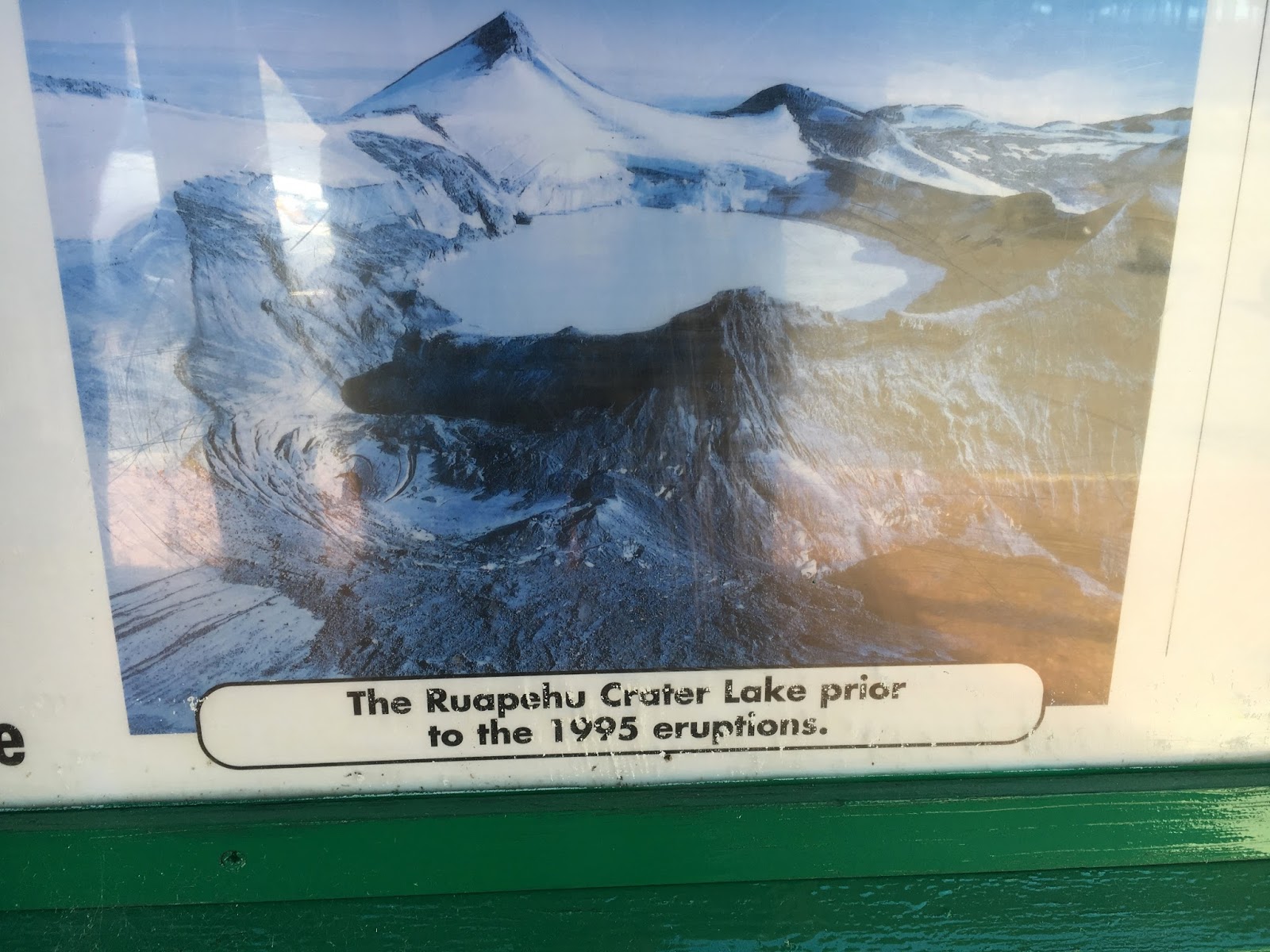
"The weather on Christmas Eve was fine and with little recent rain, no one suspected flooding in the Whangaehu River. When a goods train crossed the bridge around 7 p.m. the river appeared normal. What transformed the situation was the sudden release of approximately 2 million cubic metres of water from the crater lake of nearby Mt Ruapehu. A 6-metre-high wave containing water, ice, mud and rocks surged, tsunami-like, down the Whangaehu River. Sometime between 10.10 and 10.15 p.m. this lahar struck the concrete pylons of the Tangiwai railway bridge.
Travelling at approximately 65 km per hour, locomotive Ka 949 and its train of nine carriages and two vans reached the severely weakened bridge at 10.21 p.m. As the bridge buckled beneath its weight, the engine plunged into the river, taking all five second-class carriages with it. The force of the torrent destroyed four of these carriages – those inside had little chance of survival.
The leading first-class carriage, Car Z, teetered on the edge of the ruined bridge for a few minutes before breaking free from the remaining three carriages and toppling into the river. It rolled downstream before coming to rest on a bank as the water level fell. Remarkably, 21 of the 22 passengers in this carriage survived. Evidence suggested that the locomotive driver, Charles Parker, had applied the emergency brakes some 200 m from the bridge, an action which prevented the last three carriages from ending up in the river and saved many lives...
 In the following days, bodies stripped and mangled by the flood were recovered as far away as the river mouth, 130 km downstream. In his broadcast on Christmas Day, Prime Minister Sidney Holland asked ‘Farmers and others with property on the banks of this river as far as the sea … to keep a close watch for bodies and to send reports to the nearest police station.’ About 60 bodies were recovered by locals from the Mangamāhū section of the river. Some of the 20 bodies that were never recovered may have been washed out to sea."
'Tangiwai railway disaster', URL: http://www.nzhistory.net.nz/culture/the-tangiwai-railway-disaster, (Ministry for Culture and Heritage), updated 7-Aug-2014
While human error contributed to the loss of the Titanic, the disaster in New Zealand happened because of a volcano.  "Mount Ruapehu is one of the world's most active volcanoes. Recent major eruptions occurred in 1895, 1945, 1995, 1996 and 2006.
The 1945 eruption had far reaching effects, resulting in the loss of 151 lives on December 24th, 1953. When the eruption occurred the crater lake was emptied, and the outlet dammed. Over time the crater refilled and the dam collapsed causing a lahar (mudflow and water) in the Whangaehu River. The lahar undermined the Tangiwai railway bridge piers, and the bridge collapsed when an express train crossed it.
Through 1995 and 1996 Mount Ruapehu erupted several times closing the skifields and occasionally the airports. The possibility of a major lahar occurring again was recognised as the crater lake outlet became blocked once more in 1996 by volcanic ash. Authorities are constantly monitoring the volcano and determining measures of safely controlling the situation, should the dam brake again.

The three volcanos in Tongariro National Park —Ruapehu, Ngauruhoe and Tongariro—are very much alive.  This part of the world is indeed part of the "Ring of Fire"


Image from National Geographic
"The Ring of Fire is a string of volcanoes and sites of seismicactivity, or earthquakes, around the edges of the Pacific Ocean. Roughly 90% of all earthquakes occur along the Ring of Fire, and the ring is dotted with 75% of all active volcanoes on Earth. 
The Ring of Fire isn’t quite a circular ring. It is shaped more like a 40,000-kilometer (25,000-mile) horseshoe. A string of 452 volcanoes stretches from the southern tip of South America, up along the coast of North America, across the Bering Strait, down through Japan, and into New Zealand."  (National Geographic)
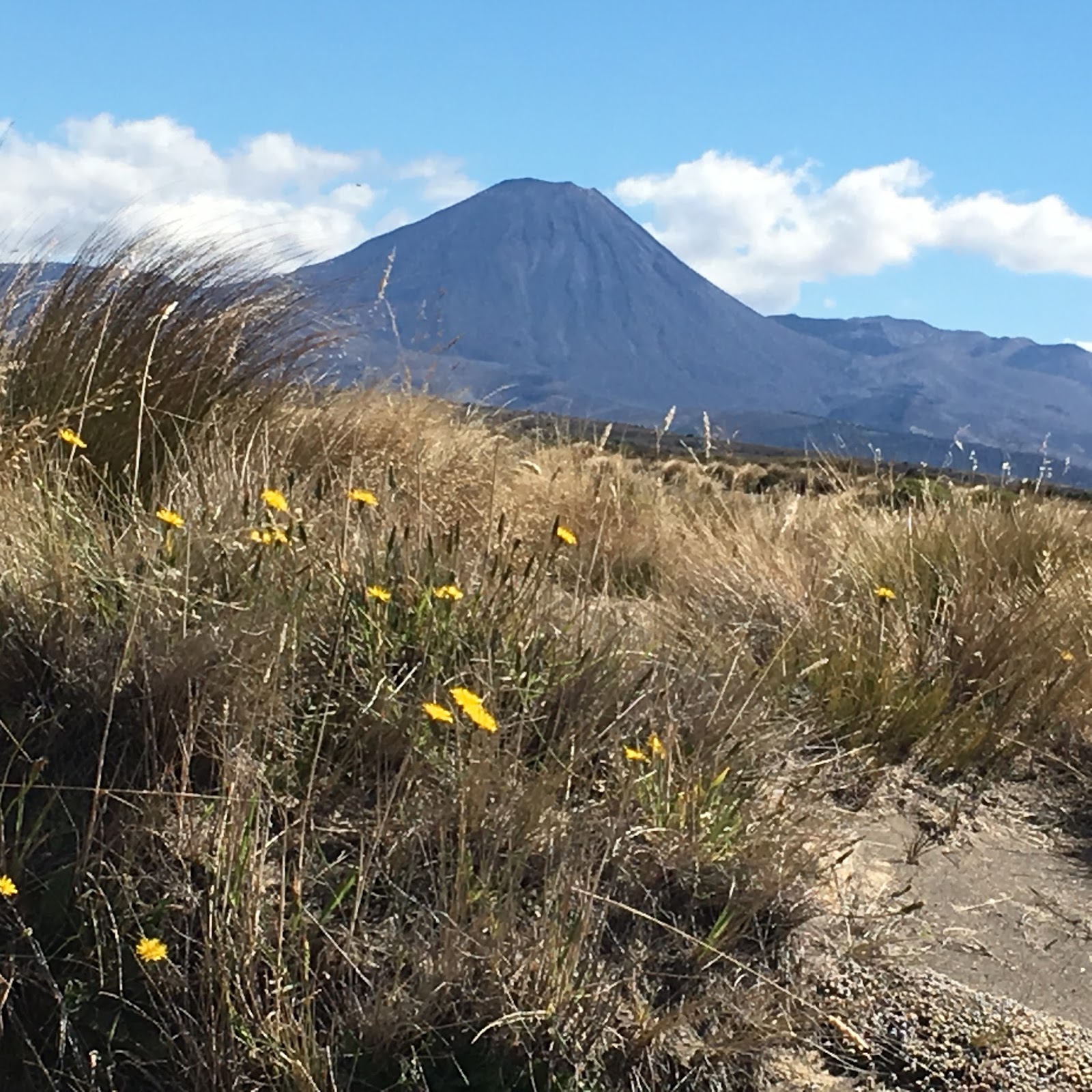
The near-perfect conical shape of Ngauruhoe was the basis for Mount Doom in Peter Jackson's Lord of the Rings movie trilogy (with some significant computer enhancement).


Movie version of Mt. Doom: Photo from Wikipedia