.

.

Sunday, February 21, 2016

Auckland Lantern Festival


This weekend we attended the Auckland Lantern Festival.  The Festival is one of the biggest and most popular cultural events in Auckland and celebrates the region’s vibrant ethnic diversity with thousands of people attending the event daily.
It is said that the holiday evolved from an ancient Chinese belief that celestial spirits could be seen flying about in the light of the first full moon of the lunar calendar.
People used torches and eventually lanterns of every shape, size and color to aid them in spotting the spirits.
The lanterns come in all shapes and sizes. Some are created in the form of animals, insects, flowers, people or even machines and buildings. Others depict scenes from popular stories teaching filial piety and traditional values. A favorite subject is the zodiac animal of the year, which in 2016 will be the monkey.


​Lanterns

Lantern Festivals have been part of Chinese New Year celebrations since the Han Dynasty (206 BC-221 AD) and are usually held on the 15th day of the first month of the lunar calendar which marks the end of New Year festivities.
The Lantern Festival is also popularly referred to as the Chinese Valentine’s Day because in days of old it gave girls and boys a rare chance to go out in the evening without chaperons. Today Lantern Festivals are held each year in China, Hong Kong, Singapore and Taiwan to mark the end of Chinese New Year celebrations.
Part of the lantern festival tradition involves a game to guess riddles attached to the lanterns. In the old days the riddles were drawn from the Chinese classics and so were mainly the preserve of the educated classes.
"Over time, the Foundation has built up a large collection of lanterns. The lanterns that appear at both festivals (here in Auckland and a similar one in Christchurch) now fill more than 20 shipping containers. Visitors to this year’s Auckland festival would be unlikely to recognize it as the same festival that was held in 2000, which was pieced together from secondhand lanterns from the Jurong Gardens in Singapore" (Asia New Zealand Foundation).


Chinese culture is full of ancient traditions, which have been used to shape the Auckland Lantern Festival over the years.


"Like most Chinese festivals, the Lantern Festival has its own special foods. including tang yuan (or yuan xiao in Northern China)— round glutinous rice dumplings with sweet or salty fillings. The shape of the dumplings symbolize both the first full moon and family unity"  (AucklandNZ.com).
This was just one of the many offering available from the LONG row of food stalls.  We sampled a few things, of course.

There were also many different performances throughout the festival, both music and dance.  I loved watching some of the traditional dances and chatting with some of the dancers as they waited for their turn to go on stage.


The whole event was fascinating for me as a once-upon-a-time Sociologist.   I enjoyed watching the people attending as much as I liked watching the performances.


However, as much as I like people watching, we left fairly early as the crowd continued to grow more and more dense as the evening wore on.  People were pouring in by the hundreds.  By the time we left around 6:00 PM we felt like salmon swimming upstream as we slowly made our way up the path to the exit against the flow of far more still entering the domain.  We were happy to get back on the bus to head home.  We were glad to have had the chance to see it all and just as glad to call it a night.
One of the things I appreciate best about living in New Zealand has been the opportunity to be in such a culturally diverse population and witness how the various groups here truly seem to appreciate each other.  I love the feeling of synergy that comes when people of many different backgrounds with different ideas, customs, beliefs and ways of living come together with mutual respect.

It isn't quite like the Zion people described in 4 Nephi:

They lived as one people and were all known as the “people of Nephi” (4 Ne. 1:10); and they ceased to recognize any distinctions among themselves, so that not only were there no Lamanites, there were no “-ites” of any kind, “but they were in one, the children of Christ, and heirs to the kingdom of God” (4 Ne. 1:17). 
Here, the distinctions between groups are very evident, and there are a substantial number of people who do not base their lives on the teaching of Christ.  Still, for the most part we have found there be almost no racial tension or sense of disharmony between classes.  In that way it is very different from the United States.  Living here has shown us how people of different faiths, different ethnicity, different values really can peacefully co-exist and build strong communities together.
As this last 8 months of our mission winds down we continue to savor every opportunity to participate in the cultural aspects of living in New Zealand, weaving these experiences together with the spiritual highlights we get from our Family History trainings.   Both sorts of opportunities are melding together to make this whole Mission experience something that will shape our views and values for all the rest of our days.


Friday, February 19, 2016

Family History in Bream Bay

We were invited to come up to Bream Bay Branch (in Whangarei Stake) to help with a scheduled Family History event.  They host a family history night on the third Friday of every month, which is fantastic, especially for a small branch.  (Their average church attendance fluctuates between 30-50 people).  While we have done stake trainings in Whangarei, this was our first time in Bream Bay. We were very impressed by the eagerness of the members to engage in Family History work.  

'Bream Bay' is loosely used as a collaboration of the three major towns that satellite the metropolitan area which are RuakakaOne Tree Point and Waipu. The physical bay itself geographically spreads from the mouth of Whangarei Harbour (Bream Head), 22 kilometers south, to the southernmost point of Waipu Cove (Bream Tail). The area also inhabits 3 native reserve islands, located just off the coast of Bream Bay: the Hen and Chickens Islands and Sail Rock Island.

The general area is made up of Ruakaka Beach, Ruakaka Township and Marsden Point. Other Bream Bay localities such as One Tree Point, Takahiwai and even Waipu are often included in general conversation regarding the area. (Latitude -35.8833, Longitude 174.4000)
Ruakaka Beach, October 2005.
Ruakaka Beach lies near the mouth of the Ruakaka River which boasts a rare bird reserve and popular summer camp ground.  It is primarily a residential area made up of a mixture of permanent homes and beach shacks.
The Ruakaka Township was developed off the back of the Marsden Point Oil Refinery expansion in the 1980s where services were required to support the large influx of workers from all over the world involved in the project. A government requirement for a percentage of revenue invested in the project to be spent on the local community allowed for provision of services not common in communities this size (e.g. squash courts, sports grounds).
The Marsden Power Station Village was built to support the Marsden Power Stations (A & B) which have since been decommissioned. The area is now promoted as beachside living.

The Whangarei Stake is very dear to us.  Of course, we love working with the leaders and members where ever we go.  Still, we have had some particularly special times in the Northlands.  So we were excited to head back up that way again.


 The meeting we helped with went very well.  Everyone had a really good time.  President Ashcroft is a wonderful leader who most definitely understands the vision of this work.  His wife and daughter both serve as family history consultants.


The congregation rents a large home on One Tree Point Road.  They have converted the garage into their chapel and various rooms of the house serve for Primary, Relief Society, Youth, Sunday School and other needs.  They have done a wonderful job adapting the place to meet their purposes. Apparently the old meeting house they had was very close to the ocean, so much so that at high tide the car park would get flooded and small land crabs would scrabble across the floor of the church.  This place is much nicer, and was a comfortable gathering spot for all.


In a rural branch where many of the members live quite a distance from where they meet for church, it is often quite a challenge to get people to come out for evening meetings during the week.  Robert Phillips, who serves as Branch President from neighboring Wellsford Branch, and his wife came to help as they are both very active genealogists but have not yet been able to generate much interest among members in their area.


The Ashcrofts can certainly understand the struggle it is for many people to come out after a long day.   Sister Ashcroft teaches Early Morning Seminary and then works during the day teaching High School French.  So by the time 7:00 PM rolls around she is often feeling fairly spent.  But you could never tell that by her demeanor.  She was so kind and friendly, as if there was no place on earth she would rather be at that time than in this meeting.  Her enthusiasm for helping other find their ancestors was infectious.

We loved the buzz of engaged conversations as members shared stories with each other about their families.


Best of all was the joy expressed when members found particular ancestors in their family lines that they could submit to do proxy ordinances for in the temple.  


Our hearts were full throughout the evening as we felt the blessings flowing. Family History is so much more than just names and dates.  The love and joy that filled those rooms was tangible.   When we finally got back to the little bed and breakfast where we were staying we were tired, but so happy.  It truly is a privilege to be part of events like this. 

The beauty of the Northlands is undeniable.  Nevertheless, it is the spirit of the people that keeps up going back again and again.  


Wednesday, February 17, 2016

Switching Gears


Right after we returned to New Zealand from Tonga we did a FamilySearch presentation for the North Shore Genealogy Branch.  We had a great time and it went very well.   The people were very kind and our presentation was well received.

 However, it is very different teaching non-member community groups about FamilySearch than the work we are used to doing with stake and ward leaders.  We enjoy both.  They simply require a completely different sort of approach.

When we are working with members our work is primarily spiritual.  We talk about why we as a people engage in family history and how it can bless our lives.   When we work with non-member community groups we focus on how the web-based program functions and answer questions about access and process.

There is an exercise we do at nearly all of our trainings.  We get the people in the room matched into pairs and have them tell each other a family story.  After four or five minutes we bring them back together as a group and ask them to identify what they were feeling during the story telling.   When we are working with members, we help people learn to recognize the Spirit of Elijah, and how that is a manifestation of the Holy Ghost teaching us about the eternal nature of families.  That is often one of the most powerful parts of our trainings.  Even though we do the same exercise with the community groups, it does not carry the same punch without the gospel perspective of what it means.

I am convinced that ANYONE who spends time learning about their family history for any reason can get benefit from this.  But those who do it with the intent of binding the generations together through sacred temple ordinances have a very different level of connection with the names that they find and the stories they hear.

So thankful that we have the opportunity for both kinds of trainings.  We meet so many great people in this mission.  I will long remember the stories I heard and the warm camaraderie among this group.

Tuesday, February 16, 2016

Tonga Beauty


We especially enjoyed the time we spent on the islands of Ha'apai.   Ha'apai is a chain of several different islands.   


We were on Lifuka and Foa.   The beauty of these islands truly captured my heart.


Lifuka and Foa connected by bridge
The bridge between the two islands


These are some shots of a few of the smaller islands I took from the plane as we were leaving:


There are reasons I would never choose to live in Tonga.  But to have this special time as a guest in the Kingdom has been a true honor.  I've come to appreciate and respect the Tongan people in many ways.  I've felt the Spirit in these islands in ways I will never forget.  I've had prayers answered.  I've learned things about myself and my testimony.   A part of my heart will forever remain here, in this beautiful land.

Third time is a charm


One of the things we were very aware of this third time in Tonga is what a huge difference familiarity makes.  The first two times we had to rely on maps and directions to find our way from one church building to another.  We often had felt apprehensive, on the edge of being lost, any time we did not have our advisors with us as guides since there are very few named streets in Tonga and those that do have names seldom are marked with signs.   

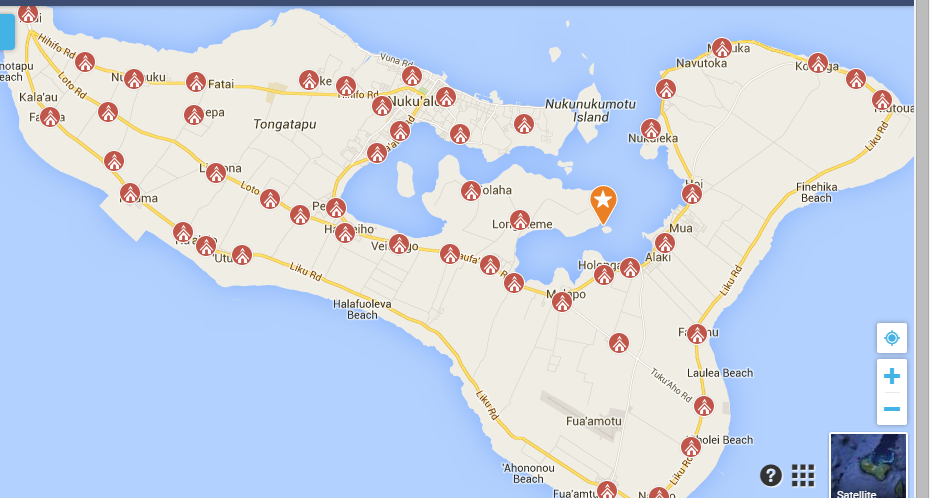
This time, however, we pretty much knew where things were (at least for the main island).   There are many LDS churches in Tonga, as the map here shows.  Fortunately, on this third visit, we recognized most of the Stake Centers.  We also were aware of several landmarks to keep us oriented to direction.  We knew where the best shops, restaurants and markets were, so even when we were on our own, we had very little trouble navigating our way around..

In addition to us feeling more confident about where to go and what to do once we got there, the people we had meetings with also seemed much more comfortable around us.  People not only recognized us, but recounted stories we had told the last time we were there.  Some chuckled over funny experiences with us.   We had built enough trust on our previous visits  for them to be much more open with us this time.

In the past, when we had asked people if they needed us to use an interpreter, some would just smile and say they could understand.  This time, people seemed more willing to admit to us when they did not understand what we were saying, and to have a true desire to know what we were trying to teach.   So with the help of Sister 'Unga to convey our words in the Tongan language, our presentations were for the most part very well received.

The last point that made a huge difference was our schedule.  In the past we did a lot more driving back and forth as we scurried from one stake to another for our different meetings.  On our last visit we had done 22 trainings in 12 days, with lots of  early mornings, late nights, and some skipped meals as we traveled from one side of the island to another to get where ever we needed to be.  By the end of it I felt positively ragged, and by the time we returned to New Zealand I was completely worn out.   This time we focused on one stake each day.  First we would meet with the Stake leaders from 10:00 AM till noon.  Then we would take a lunch break before meeting with ward leaders in the afternoon.  Sometimes we would get caught up working with the leaders in the Family History Center (FHC) and our lunch would get cut short or have to be moved back.  But for the most part we tried to keep ourselves on that schedule, which felt much more manageable than in the past.

We stayed busy, to be sure.  We got a lot done.  But we were not run ragged this time.  We were able to get well rested each night and we ate a balanced diet throughout the trip.  Those factors kept us from wearing ourselves out and it made all the difference in how this trip felt.


While staying on the church campus on the main island we would often get up early to go for a walk before starting our day.  I've been wearing the fit-bit I got for Christmas and trying to stay as diligent as possible about getting at least 10,000 steps each day.  Since our work assignment is so often sitting in front of computers to do family history work, making sure we get sufficient exercise each day to stay healthy and focused is more important than I previously gave credit for.

Road where we took our morning walks

Elder Bennett saying good morning to the cows our walk

Getting my 10,000 Steps!


I am mindful of the council that the Lord gave to the prophet Joseph Smith in D&C 10:4:
Do not run faster or labor more than you have strengthand means provided to enable you to translate; but bediligent unto the end.

We are doing a better job of following that council ourselves - pacing ourselves according to the needs of our health and energy levels, while staying diligent to use our time as effectively as we can.

Also in Mosiah 4:27 it says:  And see that all these things are done in wisdom and order; for it is not requisite that a man should run fasterthan he has strength. And again, it is expedient that he should be diligent, that thereby he might win the prize; therefore, all things must be done in order

So that is our goal at this point in our mission.  We are striving to be DILIGENT missionaries, obedient to whatever our assignment may require.  Yet we are also doing a better job of recognizing our needs for health care through getting enough rest, eating properly, having some exercise each day and making more time for quiet study, reflection and pondering.   All those things are helping us to be closer to the spirit and more open to the inspiration the Lord has in store for us to know how we can reach the people we are serving in the best way.

It feels good to be learning these key lessons.   I hope this sense of balance is something I can keep with me long after this mission is through.