.

.

Wednesday, April 27, 2016

Youth Training at Pago Stake & Return to West Stake

The next day it POURED rain all morning. We stayed in and worked on reports. Early that evening we had a Youth training back over at Pago Stake. This was to be followed by a make-up session with West Stake to catch some of the leaders we had missed when our training there had been cancelled. There was quite a bit of distance between the two stakes, so we were a bit concerned about having to leave in a rush as soon as we finished the Youth training to get over to the next one in time, but we were determined we could make it work.

When we arrived at Pago Stake we were impressed by how well supported this training was. The chapel was absolutely full with young people – we counted over 100 and they were still coming in right up till the time the training started. The energy of this training was fantastic. The young people were very engaged. From start to finish, we felt that this was one of our best trainings ever. We hoped they would remember the feelings of that night and follow through by getting active with FamilySearch.
 When we arrived at West Stake, however, only a small handful of people were there. As we talked, it became apparent that the High Priest Group Leader we had met previously had brought members of his own family. Other than that, the only other people there were the FHC director Sis.Lotoaso and the Counselor in the Stake Presidency over family history. There were none of the other leaders we were hoping to train.

Initially we were rather disheartened by the lack of support from the stake, especially since we had to rush our schedule to make this session happen. We couldn’t help but wonder if our time would have been better spent in the FHC back at Pago Stake with some of the youth leaders to be sure they knew how to use the Trees program. However, once we got going with the training, we had a truly remarkable experience with this little group that confirmed the importance of “teaching the one”.


The High Priest Group Leader who was there was Bro. Robert Toelupe. He brought with him his wife, Sinuu, plus two grown daughters and a son-in-law. As we talked about the Spirit of Elijah his whole face came alive. He told us he never really understood this before. When he had heard us talk about this, and about the Find, Take, Teach message on Saturday, he knew he wanted his family to hear the message as well. He also reached out to the counselor in the Stake Presidency and made a point of telling him how important it was for him to be at this training. Bro. Toelupe bore a strong testimony about the importance of family history and was so appreciative of our willingness to come. As he spoke we were reminded of Lehi wanting his family to come to the tree to receive the fruit. This good man was a delight to meet with. We talked to him about his role as high Priest Group Leader and how he could be an influence for good in his ward by motivating others to get involved with family history work.

Tuesday, April 26, 2016

Tuesday Trainings

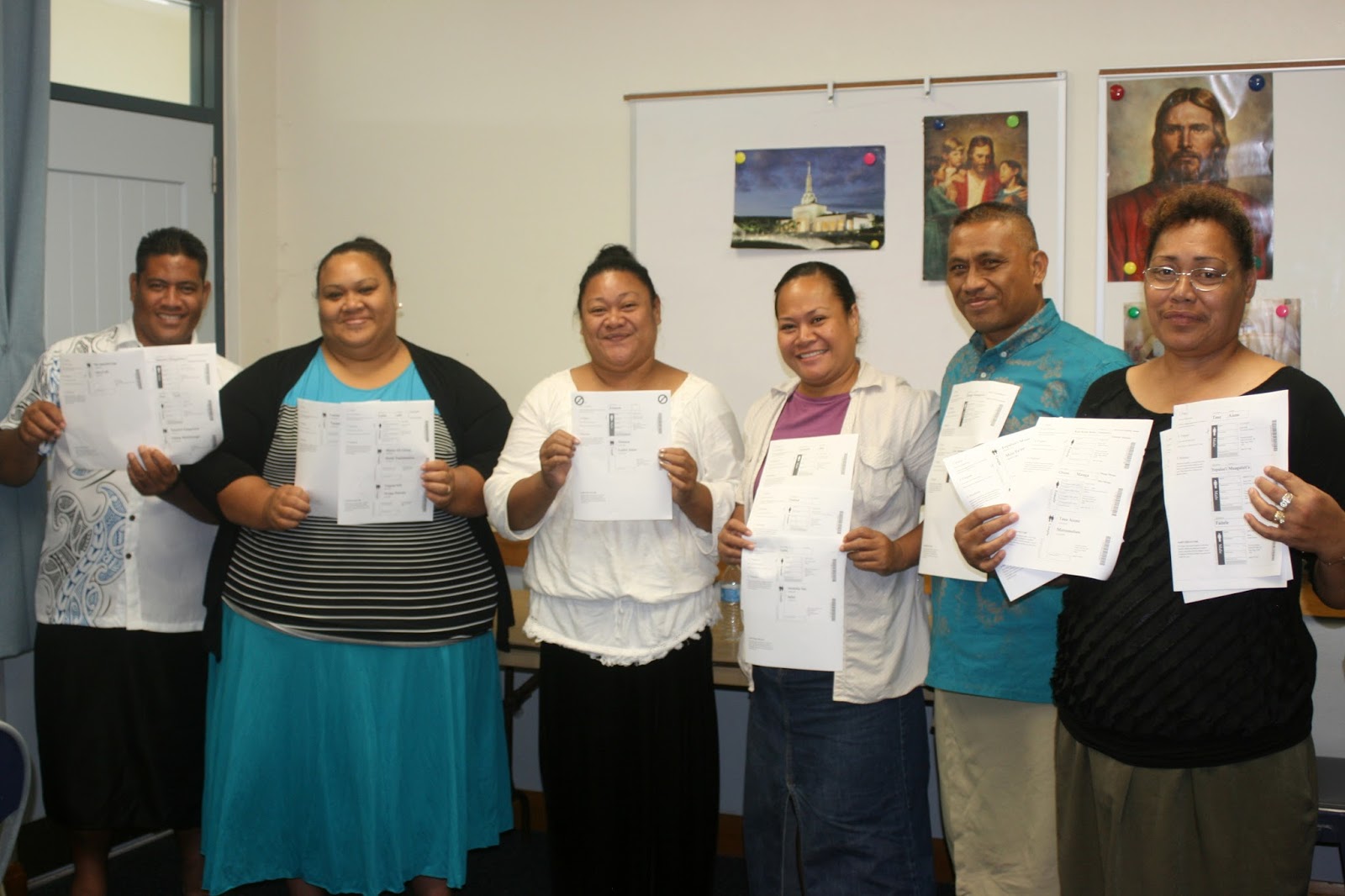
Tuesday morning we headed back to the FHC at Central Stake to be sure the printer had been installed properly. Our same two ladies were there, this time joined by another sister. We stayed there working with them till about noon answering more questions and showing them other skills like the snipping tool and decendency research. Each of them submitted a family name while were there and were proud to show off their cards they had printed.


We then went back to the Maupusaga / Malaeimi building. This is a huge stake center with a separate chapel, classrooms, offices and FHC on each end for the two stakes who share it. We were there early so we went back over to the Maupusaga side first and answered some questions at the FHC there. Then we came over to the Malaeimi side for our next scheduled training. This was another large group (over 60 people) with many ward council members in attendance.

Malaeimi Stake Presdidency and Sister Valasi Fiatamalii Apulu who did the translation for our training
On the last day we were in American Samoa we stopped at a restaurant to get some lunch. A man came up to us there to say he had been at this training and how powerful it had been. He thanked us for coming to the island, saying how important it was for many of the leaders and members to hear the messages we brought. We felt so grateful to know the work we were doing was touching hearts, even when the language barrier sometimes made it hard for us to know if we were getting through or not.

Monday, April 25, 2016

Another day in the life...

We spent several hours on Monday at the service center so Larry could install images onto two new family history computers for Central stake. It wasn’t difficult as much as it was tedious. His biggest problem was that he wasn’t really familiar with the process, but with the help of a LONG phone call to Global Support he got the job done.

While he was doing that I was able to spend some time with one of the employees in the front office who is also a Family History consultant in her ward. She had never submitted a family name before and was so excited when I showed her how to do it.

Afterward Larry and I  took the new computers to Central Stake to get them set up there. Again Larry was on the phone for a long time to Global Support in order to get the premium family history sites set up. We had some challenges getting the new machines to work with the printer, but later the Tech specialist for that stake was able to get that part done. While Larry took care of the tech set up I did some hands on training of two consultants there. Both were very eager to learn.

One of the sisters had very complicated lines in her family history that took a lot of sorting out, and of course there were the usual duplicates to review and merge. When family trees are compiled using only living memory there is a lot of guess work which often leads to mistakes. She had sons born before the mothers and daughters married to the wrong people or kids attached to the wrong family group that all needed to be painstakingly untangled. By the time we got it straight my head was swimming, but we felt good about all we had accomplished.


That afternoon we got together with the Jordons again as they wanted to take us to the local Catholic church to show us the remarkable artwork there.


As we left the church we stopped to snap a few pictures of some people we saw cutting coconuts and they were kind enough to share some with us to drink the juice. It was delicious straight from the tree


Sunday, April 24, 2016

Time with the Jordons

On Sunday the Jordons picked us up to take us to church with them. We went to a unit in Malaeimi Stake that was having a ward conference. The whole meeting was in Samoan, so we couldn’t understand anything that was being said, but hearing the choir sing was amazing.

 After church we took a drive through the National Park and saw some gorgeous views of the island.


That evening we met with a lady who had been at the West Stake training who had contacted us to say she wanted us to meet some non-members and less actives that she was working with to teach them family history.


 Afterwards we went to the Jordon’s home for dinner. We had a nice time with them talking about our respective mission experiences, sharing stories of our families and plans for when we get back home. After dinner the zone leaders came by and we got to visit with them as well. One of the young elders (Elder Barclay) came from the same ward in Idaho where Larry’s sister lives. We took several photos and told him we would email them to his mom.


  All in all we had a great Sabbath day.   We really enjoyed our time with the Jordons.  We have been blessed to meet so many fine people throughout this mission.  It also made us aware of how fortunate we are to be assigned to the Pacific Area Office where we get to associate with other Senior Missionaries on a regular basis.  The Jordons are the only Senior Missionaries on Tutuila.  They carry a heavy load acting as intermediary for the Mission President, being on the front lines as they are in looking after the young sisters and elders.  Nearly every day they end up taking someone to the doctor or dealing with some sort of emergency.  It's a heavy responsibility.

There are so many different kinds of missions.  It is amazing how all the many different people serving throughout the world are placed in the right place at the right time, matching each missionary's skills and personality to whatever sort of assignment will be best for them.

Saturday, April 23, 2016

Cyclone Amos

On Friday morning we did another training session at Mapusaga Family History Center.  We worked from 9:00 AM till a little after 1:00 PM, getting some great work accomplished. One of the wards in the stake held a Family History camp the day before. The leaders took a flash drive with the videos we had provided to show at this event. People were so impressed by the videos they were very eager to come find family names right away. Again, we felt very blessed that once we had been placed in exactly the right place at the right time to bring a message that people were prepared to receive. It is experiences like this that show us time and time again that the Lord is watching over us on this mission.


We were supposed to do another training with Bishops and Consultants from Pago Pago stake that evening. However, the Stake President called us to cancel it due to the approaching storm. While we were disappointed to not be able to hold the training we had prepared for, we agreed with the Stake President that the safety of the members was more important. The weather at that point was typical for our time in the islands – overcast skies with intermittent rain. However, we had reason to believe it could soon turn much more serious.

What had been classified as merely a tropical depression out over the Pacific had picked up steam and was now being tracked as Cyclone Amos, and it was headed our way. Each time we would check the weather reports they kept upgrading the expected force of this storm from Category 1 to 2 then 3. Having recently seen the terrible destruction done in Fiji by Cyclone Winston, we knew that storms in this part of the world could be very dangerous. Many members walk long distances on the island to come to meetings, or else ride in the open backs of pick up trucks. Not knowing what the storm would be doing by the time we were scheduled for that meeting, it just made sense in the interest of safety to call it off.

People on the island were preparing by gathering bottles of water, food, flashlights and batteries. Those that had the resources to do so nailed sheets of plywood over their windows on homes and shops. There was no extreme fear or panic, but it was clear that folks were taking the storm warnings very seriously. A team from FEMA flew in to the island to be ready to assess storm damage should a disaster strike. Everywhere we went we saw evidence of preparation. It reminded us of the scripture from D&C “If ye are prepared ye shall not fear”.


That night we spent some time on the Internet reading information about the storm and wondering how serious it would be in the area where we were. We felt relatively safe since we were staying in a well built hotel and were away from the sea. Still, it was a little scary knowing that within a matter of a few hours, things could change very fast depending on which path the storm took and how long it remained over the island.


As we went to bed on Friday night we said fervent prayers for protection, not only for ourselves, but for all the people of the islands. We spent some time quietly pondering what it means to really mean it when we say “thy will be done” and to trust in the Lord whether things turn out well for us or not. We were thinking a lot about the people of Fiji and all they had been through, or those in Vanuatu and other places where there had been devastating storms despite people of faith saying the same sort of prayers we said that night. We thought of people throughout the world who were enduring terrible hardships. Not knowing if the storm would hit hard or pass us by made us reflect more earnestly on the plight of refugees, of those in war zones, of those in areas of famine and all the other hardships people face in this world. We remembered the talks we have heard from general authorities about remaining grateful in every circumstance and determined that no matter what happened, we would put our trust in the Lord.


 The storm came over the island of Tutuila in the early hours of April 23. There were trees down n several areas. Some roads flooded. There was damage to some houses from the high winds and sea surge along the coast. However, the elements seemed to be tempered as the cyclone pattern stayed tight and close, not covering as wide an area as typical for these sorts of storms. There was no loss of life and no major devastation. We actually slept right through it. All the prayers of faith asking for protection were definitely heard and answered. We felt the love of our family and friends who had been concerned for us and who we knew were praying in our behalf.

Our 10:00AM training in West Stake on Saturday had also been cancelled, since Saturday was expected to be one of the worst days of the storm. However, by that time it was all over. So the Family History Center director called us to see if we could still come. We were delighted to do so. Many of the people who might have otherwise attended stayed home because an announcement had been made that the training had been cancelled. Still, those who got the word it was back on were so enthusiastic that we were coming. We had a great training for those who came and were touched by the expressions of appreciation from those who attended.


After the presentation we went to the Family History Center and helped several members to submit family names. Again, we loaded the training files and showed them how to use them.


When we were done we took a drive to explore that side of the island. We walked for a while along a pretty beach we found and picked up a few shells. We noticed more storm damage, but also saw people out cleaning up and doing all they could to restore order. People were smiling, children playing, and life was going on as usual. It was really a lovely day.


Thursday, April 21, 2016

More Training in American Samoa

We went back to the Mapusaga FHC at 9AM the following day to do some hands-on training in the Family History Center. This was warmly received and we helped several people to find and submit names for temple work. One of the men there brought in his guitar and an electric keyboard to share some songs with us. People continued to work, singing along the way. There was much merriment and laughter among all. It was quite an afternoon.


That evening we had a training with the Pago Pago stake which we were not quite sure how to find. Most of the stake centers are along the one main road that goes around the edge of the island, but Pago Pago stake center is set back on a different side road with no clear marker of where to turn. We called Elder and Sister Jordon, the S&I missionaries, to get directions. They met us on the way over and then drove the rest of the way to the Stake Center with us following so they could show us exactly where to go. We were so grateful to them for taking the time to do this as it was a bit tricky to find and we would have surely gotten lost without their help.

Sister & Elder Jordon
There were over 70 people gathered at the chapel. The stake president there, Johnny Mapu, felt we did not need an interpreter so we did the training fully in English. Between the uncertainty of whether everyone was understanding us and having such a big group, we felt a little less confident about how to best connect with the people there. However, as happens so many times on this mission, as we got going with the training, especially when we did the exercise where we ask people to share their own family stories, the spirit of Elijah took over. It is really an incredible feeling when we are guided by the spirit to know what to say and to be given the certainty that even if our words may not be perfect, the Spirit will bear witness to the truth of what we were trying to share.


Us with Pres Mapu and his counselor at Pago Pago Stake

Heading to Pago Pago

THURSDAY / Wednesday – April 21/20 – Switching Days Again

We got up very early on Thursday to make sure we were all ready to go for the next part of our trip.   We had just a half hour flight on a small plane, but we would be landing in another country,  so there would be some new stamps in our passports.   Although we would be leaving Apia on Thursday, 21 April, since we would cross the international  date line we would arrive in Pago Pago, American Samoa on Wednesday the 20th of April.   We felt like crazy time travelers and had to keep checking our calendar and schedule to be sure we knew what day it was and which end was up.


We had some weight limitations on this flight, so we left a box of our non essential items and the remaining groceries we had to be stored in our absence since we were checking out of House 42.  We got the place swept and wiped down and then headed to the Service Center where we met Denny’s assistant who would drive us to the airport.  

As we were leaving the Service Center, Denny mentioned there was a storm headed our direction and that the staff at the Service Center  were carefully tracking it.   The skies confirmed that we were in for some weather as it poured rain all morning, so much so that our plane had to be redirected before arriving where we were waiting to take off.  It was delayed about an hour before it could safely land there.  Once we got in the air, however, we made it across to the island of Tutuila, American Samoa without any problems.


Our time on the island of Tutuilia was an interesting case of contrasts.  On the one hand, it is an American Territory, so traffic travels on the right side of the road with the driver in the left seat of the the car.  The currency is US dollars and English is an official language.  That being said, most of the people we saw were Samoan heritage and Samoan customs and culture were very much a part of life on the island.   


Here's a bit of background information about American Samoa from Nations Online:
 "Tutuila us the largest and most populous island of the U.S. Territory of American Samoa,  The group of islands consists of the eastern half of the Samoan archipelago and comprises five volcanic islands and two coral atolls.   The main island of Tutuila and the small Aunu'u iland, plus the islands of Ofu,Olesega, and ta'u (The Manu'a Islands) to the east.  The coral atolls are Swains and Rose Atoll.

The territory has a total land area of 199 sq km (77.6 sq mi) and its highest point is at Mt Lata (965 meters) on Ta'u Island.

American Samoa has a population of 66,000. About 90 percent live on Tutuila, mostly near Pago Pago. The islands extend roughly 300 km (186 mi) from west to east and are located about two-thirds of the way from Hawaii (4700 km) to New Zealand (2800 km)."


Map of  Tutuila
When we arrived, I was impressed by the beauty of all the flowers.  They even had gorgeous flower arrangements in the bathrooms at the airport that would have been worthy of a wedding or a prom back in the States.


We took a shuttle to our hotel (The Tradewinds) and got checked in.  We had a little time to rest and get organized, then took a drive around  to get oriented to where things were.  Despite being quite a small island, there was a lot of traffic.  The other islands we go to rely more on buses and taxi, but here it seemed nearly everyone was driving in private cars.  It made getting around  a bit of a challenge.    Still, we were impressed by the tall, jagged mountains and lush beauty of Tutuila.

From .travelweekly.com


That evening we had our first training at Pago Pago Samoa Mapusaga Stake. We felt a little rattled going in, but once the meeting began the spirit took over and everything went smoothly.  The Stake President, Faapito Auapaau, provided translation for us.   The training went really well.     
President Auapaau


After the training there was pizza for everyone and much friendly visiting.  We committed to coming to the Family History Centre the following morning to help members identify family names to take to the temple.  We were tired, but happy.  We felt that our time in Tutuila had gotten off to a good start.