.

.

Friday, June 5, 2015

Return to the Northlands

We recently made another trip back up to the Northlands of New Zealand.  It was a lot of road time, but we accomplished all we set out to and enjoyed some special beauty on the way, so we felt good about the trip. 

We drove up to Kaitaia on Friday.  It's a long twisty road to get up there.  (190 miles / 306 kilometers)   As the crow flies it would not be that far, but with all the twists and turns and switchbacks through the bush around mountains, it takes almost four hours to drive it.

Looking at the map from afar it seems pretty simple.


But when I zoom in a bit I get a more realistic view of what the actual drive is like:


Let's just say it's a good thing neither one of us is prone to motion sickness.

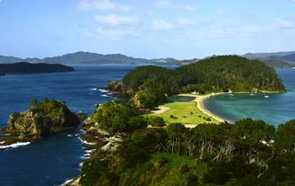
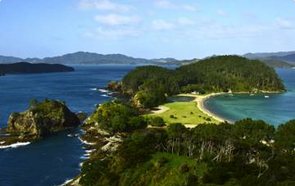
On the way up we missed one turn we should have taken at about Kawakawa, so we ended up going the long way around, through Paihia.  We were familiar with the Bay of Islands area from our previous trip up there in April.  This time we were on a bit of a tight schedule and it was pretty rainy, so we didn't do any exploring - but it was still a pretty drive.


, 


We are still struggling to learn how to say many of the place names we come across.  From road names to towns, they leave our tongues tied up in knots since nearly everywhere we go in the Northlands has Maori names. According to census figures, a little over half the population of Kaitaia are Maori, and that is very much evident when we are there. "
Archaelogical evidence shows the Far North was first settled by Polynesian ancestors of the Maori, about 900 years ago. Kaitaia has a long history of Maori occupation and the region still retains a strong Māori flavour today with many interesting structures and sites". (Kaitaia Portal)

The New Zealand Tourism Guide says:

"Today Maori people live throughout New Zealand, and many are actively involved with keeping their culture and language alive. Within any Maori community, the marae provides a focus for social, cultural and spiritual life. The term marae describes a communal 'plaza' area that includes a wharenui (meeting house) and wharekai (dining room).
Maori people define themselves by their iwi (tribe), hapu (sub-tribe), maunga (mountain) and awa (river). Whanau is the name given to family - the term embraces immediate family, in-laws and all those connected by blood ties.
In recent years, the introduction of Maori language nests (kohanga reo) has revived the Maori language. At kohanga reo, preschool children are encouraged to speak in Maori. Primary and secondary schools build on this early immersion by including Maori in the curriculum.
Traditional carvers also help to keep Maori culture alive by creating intricate works that pay respect to the past. Every piece carved tells a story, which can be read by those who know how. The shape of the heads, position of the body as well as the surface patterns work together to record and remember events."
We stayed at the Kauri Lodge Motel, which is very basic, no-frills sort of place.  But it is clean, the bed is comfortable, and like nearly all motels here they have a refrigerator/microwave/sink and cupboard full of dishes and utensils, so we were able to bring food to prepare rather than eat out.  

On Saturday morning we met with Sally Bills, the acting director of the Family History Center in Kaitaia.  (She is officially called as an assistant, but the actual director moved away some time ago.  They've never changed her title but that does not seem to be a big concern for Sally).  She is a delightful lady who we enjoyed very much.  We taught her how to use the snipping tool to create pedigree charts for leaders working on the 15-15 and showed her how to access the online version of the MyFamily book.  We discussed how the My Family 15 in 15 program has been going so far in her stake and gave some suggestions for how she encourage others to participate.  

Sally Bills - Kaikohe FHC 
As we were leaving Kaitaia we  stopped at a local farmer's market and enjoyed walking around looking at all the things that were offered there.


We bought a bag of fresh mandarin oranges and some bbq chicken on a stick and then got back on the road.  We initially planned to meet that afternoon with the FHC director in Kaikohe, but she had a family funeral to go to, so we rescheduled for Monday.

We hit the road again and headed back to Whangarei, a trip of about 110 miles.There we went back to the same farm-stay place where we were in April, "The Honey House" that we liked so much.  Again, the accommodations are very basic, but the setting is  quite lovely there.


On Sunday we attended the Hatea ward.   Both of us gave talks in Sacrament meeting and then we gave a presentation about the My Family 15 in 15 program to a combined Relief Society-Priesthood meeting.  It was very well received and we felt like it went well.   We enjoyed talking with the members and felt a lot of support.  The Whangarei Stake Presidency is very much engaged in this family history effort and is encouraging their members to get on board.  They arranged to have special meetings focusing on the My Family 15-15 goal in every ward.

Sunday evening we got together with friends we met last time we were in Whangarei.  Bruce and Doreen Savill are life long Kiwis and Rosemary Waters is an emigrant from Ireland.  They are not LDS, but the all have deep testimonies of Jesus Christ and they are the kindest people you could ever hope to meet.  Doreen prepared a lovely meal and we had a wonderful time visiting with them.  After dinner we all gathered around the piano to sing which was lots of fun.  We love these good people!


Then on Monday (1 June) we shifted over to a different place to stay so we could have Internet - The Birchgrove Cottage was a great spot for us, with a full kitchen and some nicer amenities like central heating, which we appreciated now that the weather has grown cooler. While it isn't quite as charming as the Greenfields (what we call "the Honey House") with it's farm setting and lovely artwork, in many ways it was more comfortable so for future visits we are more likely to stay there.


That day we headed back to Kaikohe for our rescheduled meeting with Cheryle Sadler, the FHC director. On the way up we did a brief stop at Lake Waro to stretch our legs and scope out the area.  We looked for a geocache that was supposed to be hidden there, but never did find it.  Perhaps with a bit more searching we would have figured it out, but we had a schedule to keep so once more we hit the road!  If we get up there sometime when we are not pressed for time we would like to go back for some more extended exploring.  It looked like a great spot for hiking or a picnic.

The Department of Conservation website had this to say about the place:
"The track through this 7.5-hectare reserve takes you through open grass land around spectacular limestone formations. The track follows the route of a historic horse tramline, built in about 1900.
The reserve is one of the most outstanding examples of a limestone landscape in Northland. Interpretation signs explain the geology of the karst landscape and aspects of the human history.
You can walk around the lake by continuing on a Council track to the Council car park making the entire walk about 2.2 km.
Since this special geological feature is so close to the highway, it is well worth a visit."


Once we got to the FHC in Kaikohe we had a good meeting with Cheryle.  We talked about ways that she could support the 15-15 goal in her area.  In addition to being family history center director, she is also ward primary president.  Because of that, she meets with her ward council.  She said she would be sure the council members there are all encouraged to meet the goal.

Cheryle Sadler


Monday night rather than hitting another restaurant since we had such a nice kitchen at the Birchgrove we just went to a local grocery store and got a few things to make supper there.  We relaxed putting together a jigsaw puzzle that was there in a closet with some games and got a good night's rest before having to head back to Auckland on Tuesday.


 On the way was stopped to make sandwiches on the road at Mangawhei Heads overlooking the beach. That's another lovely area we would like to explore further sometime when we have a bit more time.


All in all our trip to the Northlands was very successful.  We saw some lovely country and had productive meetings.  We accomplished all we set out to do.  We have come to develop a special love for this area.  As much as we enjoy seeing new places, it is kind of nice to keep going back to the same region where we can get familiar with the area and build relationship up over a period of time.   


Monday, May 25, 2015

Fasting and Prayer

Recently I have been giving a lot of thought to the principle of "Fasting".  In the culture of the LDS church, the first Sunday of each month is declared "Fast Sunday".  This means we traditionally are asked to fast  (to go without food or water for at least two consecutive meals).   We approach this fast with prayer, focusing our spiritual nature on being open to special promptings or inspiration.  We also donate whatever we can manage for the poor - at least the value of the two meals we have skipped, but more if at all possible.  It was never intended that we would calculate how much a stack of pancakes or a bowl of oatmeal would cost or what the price of our lunch might have been.   Instead, we are to recognize that ALL blessings come from God and that as we share of what we have for those who have less, we will both meet a temporal need and increase our own compassion for others.

On those first Sundays we also have the the opportunity to "bear our testimony".   The Sacrament service of  Mormon congregations all over the world reserve those days to allow members of their faith (from very young children to the aged and anyone in-between who feels so inclined) to stand up and publicly declare their belief in the church.   Ideally a personal testimony will focus on witness about the Savior, the truth of the Book of Mormon, belief in the importance of temples, or other basic doctrines of the church. It is a time for sharing brief faith promoting experiences or expressing sincere gratitude for our blessings.  Granted, there are some folks who get up and ramble on about their latest family vacation or little kids who repeat verbatim whatever is being whispered into their ear by a prompting parent.   But the objective is for people to speak from the heart of spiritual things.

I've been an active member of the Church of Jesus Christ of Latter-day Saints for over 30 years, so I have heard many talks about fasting.    I have also participated in a whole lot of "fast and testimony" meetings over the years.   Just as a rough estimate, if I were to guess I'd say I've probably attended on average ten such meetings per year (assuming I may have missed a couple here or there).  So I've been to over 300 testimony meetings and probably bore my testimony personally in about a third of those

However, the truth is, I have always struggled with fasting.

Even when I have approached a fast with sincere intent and prayer, too often rather than feeling spiritually strengthened I often just felt hungry, light headed and cranky.

Consequently, I have not fasted as often, or as purposefully as I might have.  Sure, I would generally skip breakfast on fast Sunday and then have a later dinner.   But I seldom went a full day without anything and I generally was not all that disciplined in my inner thought life during the fast.

The exception to that has been when I have been fasting outside of the ritual first Sunday protocol, when I had a compelling personal reason to do so. In addition to the structured first Sunday fasts, our faith teaches us that we also may fast any time we need answers to specific spiritual questions or struggles.  We can fast when seeking strength to endure personal trials, or if a family member or someone we care about has a particular need.  

When my oldest brother was out of work I fasted for him.  I have fasted whenever people I loved were hurting - whether it be from  physical illness, relationship struggles or other challenges.  I have fasted a number of times for my children when they were having problems.  I specifically fasted several times seeking direction as we contemplating leaving our home and family to serve a full time mission.   So I have had some deeply personal and significant experiences with fasting.

Nevertheless, I would not consider myself to have had a strong personal practice of fasting on an ongoing basis.  Too many times when I recognized a situation might merit a meaningful fast, I just said my regular prayers and hoped that would be enough.  I took the easy way out.

However, ever since hearing Henry B. Eyring's talk about fasting in last April's General Conference: "Is This Not The Fast That I Have Chosen"  I have been giving some thoughtful reflection to the role that fasting plays in my life.  I wanted more than an intellectual understanding of what it is or knowledge about what it is supposed to make possible.  I wanted to have a strong enough personal testimony of the law of the fast that I would be able to incorporate the practice more consistently in my own life.


Additionally, as Elder Bennett and I have been studying Ch.6 in Preach My Gospel with focuses on the attributes of Christ,  I had been recognizing that I wanted to develop a stronger personal testimony of the law of the fast as a means of developing some of those attributes more fully in my own life.   So I had been including this in my personal prayers, hoping I would gain some new insights.

Then we were sent to Tonga.  The nine days that we spent on the island of Tongatapu were a blur of meetings, travel, prayers, answers to prayers, and special spiritual experiences .  On the day before we were to leave, we attended church in the Liahona ward, which is an English speaking ward.  I looked forward to being able to hear the messages that were to be shared that day, but frankly, I was feeling tired, somewhat overwhelmed and distracted.   We had little rest throughout our time on the island and so much had happened.  So when I went into the Relief Society class for women, I was just quietly sitting there reflecting over it all, not actually paying full attention to what was being said.

And then it hit me....the lesson that day was specifically about fasting.   It was actually a re-telling of the same talk by Henry Eyring that I had just heard a few weeks before.  So it was not new information that I was receiving.   Still, as that lesson unfolded, I felt a strong personal witness of the truth of the word being said.   It was as if the Holy Spirit were tapping me on the shoulder and saying: "Hey, you said you wanted to understand more about fasting.  Listen up!  This is your answer.  This lesson is for YOU.   Pay very close attention.   This can change your life."

I felt goosebumps.   All through the lesson I kept getting the unmistakable feeling that the thoughts and experiences being shared by the women in that room were specifically for my benefit as a direct answer to my prayers.

The young woman who was the teacher / discussion leader for that day divided the group into sections of  3 to 5 women and gave each section a scripture or quote to talk about among themselves for 5 minutes and then at the end of the discussion period we were to report back to the whole class about what we had learned from it.  The section I was in got the following quote from President Eyring's talk:

" President Spencer W. Kimball called failing to follow that law a sin of omission with a heavy cost. He wrote: “Rich promises are made by the Lord to those who fast and assist the needy. … Inspiration and spiritual guidance will come with righteousness and closeness to our Heavenly Father. To omit to do this righteous act of fasting would deprive us of these blessings.”  (Referring to the book  Miracle of Forgiveness, p. 98).

Those words hit me like a ton of bricks.  I knew that I had been missing out on spiritual experiences when I shortchanged those opportunities for a meaningful fast.  I also felt an absolute certainty that by increasing my faithful willingness to participate in a full fast with purpose and prayer I could have more inspiration and spiritual guidance.  I knew this was meant for me.   There was no doubt.

I quietly pondered that in my heart as the meeting ended and then we went on through a Sunday School class that was very well presented.  When we moved on into Sacrament meeting I sat near the back with Larry and with Elder and Sister Beckstrand who also attend Liahona ward.  I was prepared to simply listen to whatever talks were to be given that day.   However, the Bishop asked Elder Bennett and I to come forward to bear our testimony.  So we did.

As I was speaking about my testimony of the gospel and my gratitude for my mission experiences I felt prompted to share the feelings I had in Relief Society about the lesson on fasting.  I explained how hearing that lesson was a direct answer to my personal prayers and had filled me with very special feelings of recognizing the truth of those words.

At the close of the meeting the bishop stood up and said something like this (loosely paraphrased):

    I was touched by Sister Bennett's words about how the lesson about fasting was an answer to her prayer.   You know, we plan out the topics of lessons for our meetings months in advance.  I remember praying to know what things would be of most importance in the meetings coming up.  I had a strong impression that on this particular Sunday we should have a lesson about the Law of the Fast.  I did not know Sister Bennett at that time.  I did not know she would be coming to our island.   I did not know she was seeking to have a better testimony about this.  But the Lord knew.   So the Lord directed me to choose that topic for this particular Sabbath.   I feel a witness that this is His church.  I was directed to plan this study topic because Heavenly Father knew it would bless the life of one of his daughters, and perhaps others.  Prayers are answered.  The Lord knows us personally.


Sister Lynda Bennett with Bishop Vatuniloka Fifita, Liahona Ward
I thought I had experienced a strong spiritual witness before when I was in the Relief Society class.  When I heard the Bishop speak these words, I came utterly undone.  All I could do was weep.  I KNEW with no doubt whatsoever that the Lord was very much aware of me, aware of my needs, aware of my feelings.  I felt an overwhelming sense of love from the Savior and from my Father in Heaven confirming that I was exactly where I needed to be and that they were mindful of my every step.  I felt a renewed confirmation of our mission to the Pacific, knowing that it was not random that we should come here.   I felt a renewed certainty of truth of the gospel of Jesus Christ.  The reality of it all just came thundering through my mind and heart and spirit with a degree of conviction I could barely comprehend.

I hope I will never forget that feeling.

There are many scriptures about fasting and there have been some great talks by various church authorities on the topic.   Here are some links to just a few:


"Fasting With Power" - Shayne M. Bowen,  April 2009

"The Blessings of a Proper Fast" - Carl B. Pratt,  Oct 2004

"The Law of the Fast" - Joseph B. Wirthlin, April 2001


Thursday, May 21, 2015

Royalty in Tonga

Our hotel where we stayed in Nuku'alofa was just down the street from the Royal Palace where the king lives.  While the Tongan Parliment and Prime Minister have a significant role in the government of this island nation, the Royal Family are still very important.


According to an article by Guy Powels (1905-1994) "The Constitution of Tonga confers absolute powers on the Monarch who can choose whether to exercise them in person or to delegate them to others.  While the Monarch is not concerned with the details  of the day­-to-­day government of the country, the Monarch has the constitutional power to intervene at will" .(See "Testing Tradition in Tonga: Approaches to Constitutional Change").

After significant unrest and upheaval in 2006, however, reform began to come to the monarchy.  In 2010   "King George Tupou V relinquished most of his powers... ending 165 years of feudal rule...For the first time in the island's history, most MPs were chosen by the people and, while the Oxford-educated monarch remains head of state, he will lose his executive powers, including the ability to appoint the prime minister and ministers."  (Malkin, Bonnie. 2010. The Telegraph.  "King Relinquishes Power in Historic Vote.")


King George Tupou V Associated Press Photo

According to The Commonwealth:  "Under the 2010 constitution, Tonga is a constitutional monarchy and a parliamentary democracy with a unicameral Legislative Assembly consisting of 26 elected members, nine of whom are elected by and from among the country’s 33 hereditary nobles, and 17 on the basis of universal adult suffrage (women received the vote in 1960) in a general election which must take place at intervals of no longer than four years. Up to two cabinet ministers who are not already elected Assembly members become ex officio members

Despite changes in the degree of power the King (or Queen) may have in government, the various royal residences and royal burial sites are still significant parts of Tonga, reminding people of their long history of rule by royalty.


The kings and queen of Tonga since the founding of the constitutional monarchy in 1875:
(also known as Taufa'ahau Tupou I)
Reigned 1875-1893

King George Tupou II
Reigned 1893-1918

Queen Salote Tupou III
Reigned 1918-1965

King Taufa'ahau Tupou IV
Reigned 1965-2006

King George Tupou V
Reigned 2006-2012

King Tupou VI
Reign 2012-Present


History:
Between 1799 and 1852 Tonga went through a period of war and disorder. This was finally ended by Taufaʿahau, who was converted to Christianity in 1831 by the Methodist missionaries. He became Tuʿi Kanokupolu and subsequently took the title King George Tupou I in 1845. During the king’s long reign (1845–93), Tonga became a unified and independent country with a modern constitution...(from Encyclopedia Britannica)

This king formally dedicated the land of Tonga to the protection of God and through his influence Christianity became an important part of Tongan life.

In August 2014,Ensign magazine published an article about the role of the church in Tonga by  Harvalene K. Sekona, Principal of Liahona Middle School titled "Tonga-a Land Dedicated to God".  

BYU produced a short documentary about Tonga called "Tuka Fanua - the Land Given to God" which can be seen on YouTube HERE.  (just over 45 minutes long).

Royalty not only lives different from the common people, they are also given different status when they die.  

From Flikr: "The current day site of the Royal Tombs is in central Nuku'alofa, the capital of Tonga. Following the death of King Siaosi (George) Tupou I in 1893, rather than being buried at the dynasty's burial grounds, the Government decided that as King Tupou I united the country, he and his direct descendents should be buried in central Nuku'alofa. The grounds were called Mala'ekula (Red Ground). Today, the Mala'ekula is considered a sacred site."

I'm posting the photos I took - but there are some much better ones posted by Keith Clark HERE.


"Muʻa is a small town in the Hahake (eastern) district on the island of Tongatapu, and it was for centuries the ancient capital of Tonga. It is divided in the villages Lapaha and Tatakamotonga, is close to Talasiu and famous for the ancient langi (royal burial tombs)."   (Wikipedia)

One of the royal residences we always took notice of when driving around the island was "the Princess's home", because there were the two big tiger statues marking the driveway.


I never was told which princess lived there and I have no info of why she chose these particular monuments to decorate her driveway.  But in a land with very few named streets or road markers, they were a great landmark on the main road for us.


Malapo

We had a very full schedule of trainings every day we were in Tonga. We met so many people and went to so many different places that it all sort of runs together in a blur in my mind.  All together we visited 13 Family History Centers and gave presentations to church leaders a from a dozen different Stakes.  But one of the trainings  that we did that really sticks out for me is the time we spent with Malapo FHC on Thursday.  We were only scheduled to go to East Stake and Mu'a Stake that day, but the director at Malapo had called the Area Advisors to ask if there was any way possible we could make time for them too.  Of course we agreed.

Our time there was so special.   Larry worked with a young couple, Seini and Havea Pakalani, who had never signed on to Family Search before.  He showed them how to get a free LDS account and then how to log on and begin building their family tree.  For both of them he was able to help them get all 15 names of their 4 generations within less than 15 minutes.


\


We both really enjoyed meeting this couple and their children (son Wellington, age 3 and daughter Seilaine, aged 5)


While Larry was giving them a lesson in Family Search basics, I worked with the FHC director to show her how to use the snipping tool to save screen shots of pedigree charts for each member of the Stake Council and also showed her how to do the MyFamily book online with a place to select which language to have the pages appear in.

The director and each of the consultants were proud to show me they had completed all 15 of the names they needed for the four generations.  Even though it was clear to see they were all there when looking at the screen, with each one we made a ceremony of counting off each ancestor with cheers and clapping every time we hit fifteen.   The ladies beamed with pride at knowing they had fulfilled the Area Presidency goal.  Some were a little shy to have their photos taken, but through our conversations I knew they were very happy to show they were done.


 I encouraged them to reach out to the members of their stake council to help them also get the full 15 in 15 accomplished, telling them to praise each one who finishes this in the same way as I had done for them.  We talked about the value of  family stories and I instructed them to encourage each council member to get some of their stories written down.

The whole time we were with the Malapo Stake members we just felt so connected, so certain we were exactly where the Lord wanted us to be.  We were able to share testimony with these good people about the importance of preserving family heritage and all of us felt a bond with one another that is impossible to describe.  It was a wonderful blessing to be there.

Tongan Beauty


Most all of our days were long while working in Tonga.  We got up with the sun and were on the road by 8:00 AM.  We generally would go to two or three different family history centers during the day and then have a leadership meeting in the evening.  We usually would get back to the hotel about 8:00 or 8:30 at night and then we'd spend a few hours doing computer work putting together reports.  So by the middle of our time there, we were just plain exhausted.  The last few days we rolled through on auto-pilot.  Still, I feel really good about all we accomplished and grateful for some of the special spiritual experiences we had there.

We definitely were not there to tour points of interest, but sometimes we got to stop along the way as we traveled from one training location to another to see some special places.

One place in particular we enjoyed while in Tongatapu was the blowholes.  According to
 World Travel Guide:

One of the most impressive sights in Tonga are the Blow Holes, found along the coastline at Houma, 14.5km (9 miles) from Nuku'alofa. Waves send sea water spurting some 18m (60ft) into the air through holes in the coral reef. This stretch of coastline is known as the Mapu 'a Vaea (the Chief's Whistle) by Tongans because of the whistling sound made by the geyser-like spouts.


Another special spot was Hina cave, were we stopped to eat lunch one day.  The beach there was gorgeous and then the cave was an intriguing spot to have a picnic lunch.


Apparently the nearby resort hosts entertainment in the cave at night - various Tongan dances are demonstrated, including a fire dance.  If we ever go back to Tonga, that's something we would like to see.  For this trip, however, we were just glad we got to see the place.

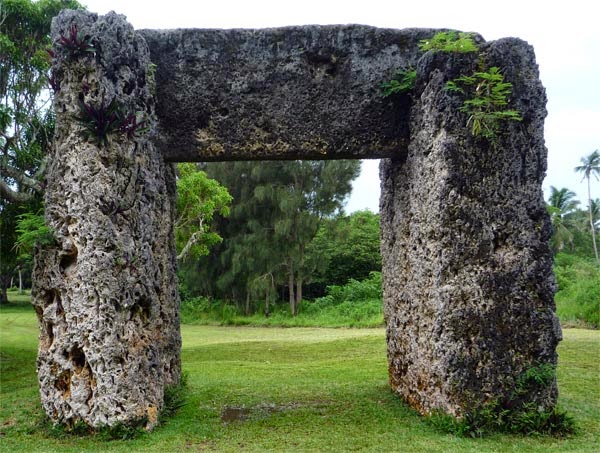
Another interesting spot was the Gate of Ha'amonga a Maui.  These giant stone have various stories associated with them.  They are made of coral limestone which is speculated to weigh several tons.


UNESCO has the following information about this giant archway:

"It is said that the 11th Tu'i Tonga, Tu'itatui, built the trilithon about 1200AD whilst in power. There are many theories about this construction. It is believed that it was used as a gateway to his Royal Compound, Heketā. The two upright stones are said to have represented his two sons, Lafa and Talaiha'apepe, with the lintel uniting the columns symbolizing the bonds of brotherhood. The Tu'i Tonga was concerned his two sons might quarrel after his death and erected the monument as a reminder to stay united. It was they who decided to move the centre of government to Lapaha in Mu'a (third capital). It is also said that they preferred a more calm anchorage site for their great double hulled canoes which were the most common means of transportation for long distance voyages in those days, and Lapaha offered the ideal site.


Of recent, after research of the Ha'amonga a' Maui initiated by the late King, His Majesty King Taufa'ahau Tupou IV, in 1967, the Palace Office in Tonga reports that the creation and importance of the Ha'amonga ‘a Maui is based on its relation to the sun, which is extremely significant in Tongan Culture for every day activities. Notches are found carved on the top lintel that indicate (1) the longest day, (2) the shortest day and (3) when the sun is directly above the equinox. The sun rises and sets at exactly the same spot and the Ha'amonga Archway pin points those points on the horizon. The sun equinoxes are the half way points in which the sun rises in accordance with the earth moving north and south. This archway is an entry and departure to the heavens that is observed by navigators, sea going farers, farmers, harvesters, and even the planters are some of the people that utilized the sun clock to assist their existence on earth."

So even though we were not their as tourists, we did get to see some beauty and places of interest.
Tonga is a fascinating place.


Wednesday, May 20, 2015

Our Temple Experience


I have a friend back in the states who served a mission in Australia some 40 yrs ago.  One of the companions he had at that time as a young Elder was Louie  Wolfgram.  Elder Wolfgram is now serving a senior mission with his wife here in Tonga.   So when my friend Mike heard we would be traveling to this part of the world as part of our assignment, he was very eager for us to look for his former missionary companion to bring greetings.  I promised I would do my best to find him.

However, our trip here has been very busy.  With one thing and another, I really have not had a chance to try to locate this man.

Then on Wednesday we had a chance to go to the temple.  We were nearly exhausted from traveling all over the island doing various trainings.  I knew that some time in the temple would be exactly what I needed as a "spiritual shot in the arm" to help us get a second wind.

On the way in to the temple I was thinking about this man that my friend wanted me to look for, but I could not remember his name.  I had it written down in my notebook back at our room.  Unfortunately without that note there was no way I was ever going to know who to ask for.   I felt bad because I didn't want to let my friend down.  By that point, however, I was so tired I barely remembered my own name!  So I let go of the concern, went on in and had a nice session. 

After the session was over, as I was walking out of the main corridor towards the front door one of the men who I had seen at the session noticed my missionary badge and asked what my assignment was.  I told him my husband and I were were there for Family History and we chatted a bit about the nature of what it is we do.  I was just getting ready to walk away to meet Larry and head home when I suddenly got a very strong prompting that THIS was the man I was supposed to look for.  I had absolutely nothing to base that on.  I just knew.  So I asked him if he knew my friend Mike back in Idaho.  The man broke out in a big grin of recognition and eagerly said that he knew my friend.  We talked some more about their time together as young missionaries and I was able to keep my promise of extending greetings from him.

Even though in my scatterbrained, exhausted state I did not bring the note and really had no memory of who I was supposed to look for, I was guided to find him and to recognize him in a way that I know was influenced beyond my own knowledge.

Just one more in a growing stack of missionary miracles to remind us the Lord knows us personally and is mindful of our needs.

The Soundtrack of Tonga


                                                      The hotel where we stayed -  "Little Italy"

We saw much beauty while we were in Tonga - especially the gorgeous sunrises and some truly stunning beaches.  But I also want to remember the sounds of our time there.  

We laughed about the music that would be playing in the hotel dining room each morning when we went down for breakfast.  On the first day it was almost all old Elvis Presley songs.  The next day we had the following playlist:

Doris Day - Que Sera Sera
Bob Marley - Don't Worry, Be Happy
Journey  - Don't Stop Believing
Then some Italian opera song, followed by Latin Salsa
followed by  Dean Martin - Volare and then "There's a Party" - not sure of the artist.

Talk about random mix of genres!

We were cracking up at the selection, making wild guesses about what would be next after each song.

Here are a few images from the hotel:


I described a bit more about the sounds of  Tonga is a letter home to an old friend:

In one passage of that letter I said:


"Yesterday as we did some training in one of the Family History Centers we kept hearing the rhythmic tap tap tap of village women making tapa cloth. Then that evening at a meeting held for stake presidents we kept hearing sounds of choir practice drifting over from another part of the church with their stunning a cappella harmonies. It was like being surrounded by angels and the gentle breeze off the ocean felt like the breath of God. Unfamiliar birds chatter in the trees, with sounds more brilliant than their plumage, against a backdrop of the ever present swish of the ocean as tides lull in and out. All these and more swirl together in our heads as the soundtrack of this place. Add to that late night rooster crowing from midnight till 3AM (what's up with that?), barking dogs and squealing pigs...we are at times on sensory overload. I find myself longing for stillness, to more fully ponder all we are encountering here."


I could definitely do without the late night animal noises. But the sound I will remember most of all is the singing of the Tongan people.


Here is just a small sample:


The music my heart will remember the most will be from the evening we trained leaders from the  Nuku'alfo North Stake.  We met at the Matavaimo'ui Stake Center. The feeling in the room that night was so powerful, and their singing locked those impressions into my mind.


I will remember the laughter of children.  I will remember the sounds of the sea.
But most of all, I will remember the singing.

It it something I will carry with me, I hope, for many years to come.